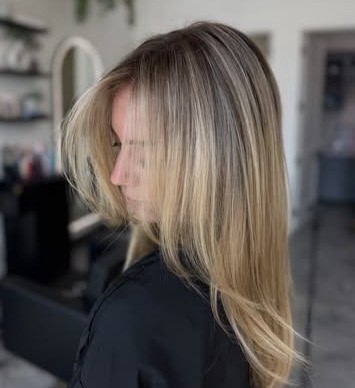
Short answer: If you are growing your hair out, trim it every 8 to 12 weeks — and trim less, not never. At The Opal & Ivy Salon in Baton Rouge, most growing-out clients do best with a small trim of about a quarter to a half inch every 10 to 12 weeks. A female haircut is $59 here, and a bang trim is $17 between full appointments. Skipping trims for six months does not save length. It usually costs length, because split ends travel up the strand and the next cut has to take more.
I am Tiana Wong, owner of The Opal & Ivy Salon, a private suite at Suites at Long Farm in Baton Rouge. “I want it longer, so I am not cutting it at all” is one of the most common things I hear in my chair — and I understand it. Here is the honest math I walk my growing-out clients through, and the schedule that actually gets hair longer and healthier at the same time.
The split-end math, in plain numbers
Hair grows from the scalp, not the ends — roughly half an inch a month for most people, about 3 inches in six months. Your ends are the oldest part of your hair, worn by months of heat, sun, ponytails, and Louisiana humidity. When an end splits, that split does not stay put. It travels up the strand, and the hair thins and starts breaking off on its own.
That is the part most people miss: untrimmed hair does not just stop looking neat. It starts losing length from the bottom while it gains length at the top. Put the two schedules side by side:
| Schedule | What happens over 6 months | Net result |
|---|---|---|
| Trim about 1/4 to 1/2 inch every 10 to 12 weeks | About 3 inches of new growth, minus about 1/2 to 1 inch total in small trims | Roughly 2 to 2.5 inches of healthy length gained, with clean ends |
| No trim for 6 months | About 3 inches of new growth, but splits travel up and ends break and thin | Often 1 to 2 inches has to come off at the next cut just to reach healthy hair — and the ends looked stringy the whole way there |
Those are typical numbers, not a promise — growth and wear depend on your hair, color, and heat use. But the direction is consistent in my chair: small, regular trims keep almost all of your growth. Growing out is a trimming plan, not a no-cutting plan.
The schedule I give my clients, by hair type and habits
Eight to 12 weeks is the range I work in — the same range on our haircut page — but where you land depends on what your hair lives through:
- Every 8 weeks if you lighten or color your hair, heat-style most days, or your ends are fine and split easily. Lightened hair is more fragile — the same clients on a toner schedule (see how to keep blonde hair bright in Louisiana water and humidity) usually need the shorter interval too.
- Every 10 weeks for most growing-out clients. This is the sweet spot I book most often: long enough to see real progress between visits, short enough that splits never get a head start.
- Every 12 weeks if your hair is rarely colored, you use little heat, and your ends still feel smooth and full. Twelve weeks is the outer edge I am comfortable with — past that, damage usually costs more length than the trims would have.
If you wear a fringe, a bang trim is $17 and takes minutes — it keeps the front tidy while the rest of your hair is left alone to grow.
A trim is not a haircut — what to ask for
A lot of the fear here is really about communication. A full haircut reshapes your hair. A growing-out trim — sometimes called a dusting when it is very light — only removes the worn ends and keeps your shape. In my suite, tell me three things: that you are growing it out, when your last trim was, and the most you are willing to lose today. There is no double-booking and no handoff — I cut your hair start to finish, and I remember your goal from last time.
At Opal & Ivy, the $59 female haircut includes a short consultation, a relaxing cleanse, the precision cut, and a styled finish, so you leave seeing how your hair falls at its new length. Planning a dramatic change instead? Book the free consultation first. Common first-visit questions are on our FAQ page.
Signs you have waited too long between trims
- Your ends feel rough or look see-through compared with the hair above them.
- Your hair tangles at the bottom first, even right after brushing.
- You see small white dots or tiny splits when you hold an end up to the light.
- Your style stops holding — the bottom flips, frizzes, or goes flat while the top still behaves.
- It has simply been more than 12 weeks. Damage at the ends is quiet at first; waiting for obvious signs usually means waiting too long.
If two or three of those sound familiar, do not book a big chop out of frustration. Book a trim, tell me you are growing it out, and let me show you — before I cut — where the healthy hair starts. Most clients are relieved by how little has to go at that stage.
How to protect your ends between appointments in Louisiana
Trims do half the work. The other half is slowing how fast your ends wear. Louisiana humidity swells hair and tangles fragile ends, summer sun dries them out, and a ponytail in the same spot every day snaps the same strands. Use heat protectant every time you heat-style, lower the temperature instead of adding passes, move your ponytail position, and work tangles out gently from the bottom up. That is how a 10-week client stays a 10-week client instead of sliding to 8.
Frequently asked questions
Does trimming make hair grow faster?
No. Growth happens at the scalp, and trimming the ends does not change it. What trimming does is stop you losing length at the bottom to splits and breakage, so more of the growth you already make actually stays. It looks faster because it finally adds up.
How much comes off at a growing-out trim?
Usually about a quarter to a half inch — just the worn ends. If it has been many months, it can be more, because the cut has to reach healthy hair again. That is why the regular small trim protects you: it is always the smallest possible amount.
Can I go 6 months without a trim if my hair feels fine?
You can, but I do not recommend it, even for healthy hair. Ends keep aging whether they bother you or not, and by six months splits have usually traveled well past a dusting. A planned schedule you can keep beats a rescue cut later.
How much does a trim cost at Opal & Ivy?
A female haircut — consultation, cleanse, precision cut, and styled finish included — is $59. A bang trim between appointments is $17. Consultations are always free. If your hair needs more than a standard appointment, I will tell you before we start, never after.
Should I trim before or after color?
Either can work, and we will plan it together. Many color clients trim at the same visit as a refresh, so lightener-stressed ends are cleaned up on schedule. On a lived-in color plan, trim and color intervals usually settle into the same rhythm — see how long balayage lasts and the lived-in maintenance schedule.
Ready to grow it out — without losing it at the ends?
If you are growing your hair out in Baton Rouge, let us put you on the schedule that protects your length: a small trim every 8 to 12 weeks, agreed out loud before anything is cut. Book on Vagaro at vagaro.com/theopalandivysalon or call (225) 450-5956. The Opal & Ivy Salon is a private suite at Suites at Long Farm, 14660 Village Market St, Baton Rouge, LA 70817 — one stylist, start to finish, and your growth goal remembered at every visit.
Leave a Reply